The Yemeni Truth

The True History of Coffee

From Sufi mystics to the New York Stock Exchange — the 500-year story the industry does not tell.

1450
The Sufi Spark

The Sufi Spark

Five hundred years ago, in the highlands of Yemen, a group of Sufi mystics discovered something strange. The red cherry that grew on the mountain terraces — wild, bitter, brought across the Red Sea from Ethiopia — could be boiled into a drink that kept them awake for their night prayers (Dhikr).

They did not seek profit. They sought presence. And in doing so, they invented the coffee beverage.

The wild berry was Ethiopian. But the wild berry was undrinkable — bitter, unpredictable, unprocessed. Yemen took that seed and spent three hundred years selecting, terracing, drying, and roasting. They built stone terraces at 7,000 feet. They invented the dry-processing method. They roasted the first deliberate cup.

This is not opinion. This is agricultural history.
1650 – 1850
The Port of Mocha

The Port of Mocha

By the mid-17th century, Yemen's capital had shifted from mountains to a mud-brick harbor called Mocha. It was not beautiful. It was not large. But it was the single most valuable point of failure in the global economy.

For 200 years, the Port of Mocha was the world's first luxury monopoly — the Silicon Valley of the 17th century. Every empire — the Dutch, the British, the French, the Ottoman — wanted access. Every empire paid the price.

The port's name became synonymous with premium coffee. And later, by accident, with chocolate — because the Yemeni bean tasted naturally of cocoa.

1616
Empires at Sea

Empires at Sea

Monopolies attract thieves.

In 1616, the Dutch East India Company smuggled Yemeni seeds out of Mocha — not Ethiopian seeds, because Ethiopia had no coffee trade to steal. Those Yemeni heirlooms became the foundation of coffee cultivation in Java, Sumatra, and the Americas.

The British blockaded the Red Sea. The French sank British ships. Pirates patrolled the routes between Mocha and Europe, hanging from gallows when caught but dying rich.

Every major European power drew blood over this bean. And not a single cannon was fired for Ethiopian coffee.
1670s
The First Trademark War

The King's Court

By the 1670s, London was flooded with counterfeit "Mocha" — cheap beans sold at premium prices. Coffee traders sued. The courts were overwhelmed.

The King of England sat in judgment. He ruled that only beans bearing the seal of the Port of Mocha could be called "Mocha." It was the first protected designation of origin in trade history.

Before the FDA, before EU labels, there was a king and a counterfeit bean.
NYSE
Wall Street Voted for Yemen

The NYSE Rejection

Decades after Yemen's monopoly faded, the world tried to replace it. African Robusta — hardy, cheap, caffeine-dense — was presented to the New York Stock Exchange as the future of coffee.

The Exchange rejected it. Wall Street said, in effect: "This is not true coffee. We demand the Yemeni standard."

The same market that judges gold, oil, and wheat — the most ruthless financial institution in history — voted for Yemen. Not Ethiopia. Not Brazil. Yemen.

That is not marketing. That is financial history.
1700s
Why Britain Switched

The Tea Turn

For most of the 17th and 18th centuries, Britain was a coffee-drinking nation. And that coffee came from one place: Yemen, via the Port of Mocha.

The coffee houses of London — Lloyd's, the London Stock Exchange, the intellectual engines of the Enlightenment — were fueled by Yemeni beans.

Then the quality collapsed. As the Yemeni coffee monopoly weakened, Europe began to source coffee from elsewhere — Java, Sumatra, the Americas. But the quality was not the same. Britain turned to tea — not because they preferred it, but because they could not get the Yemeni coffee they wanted.

If Yemeni coffee had remained available at its historic quality, Britain might never have become a tea-drinking nation.
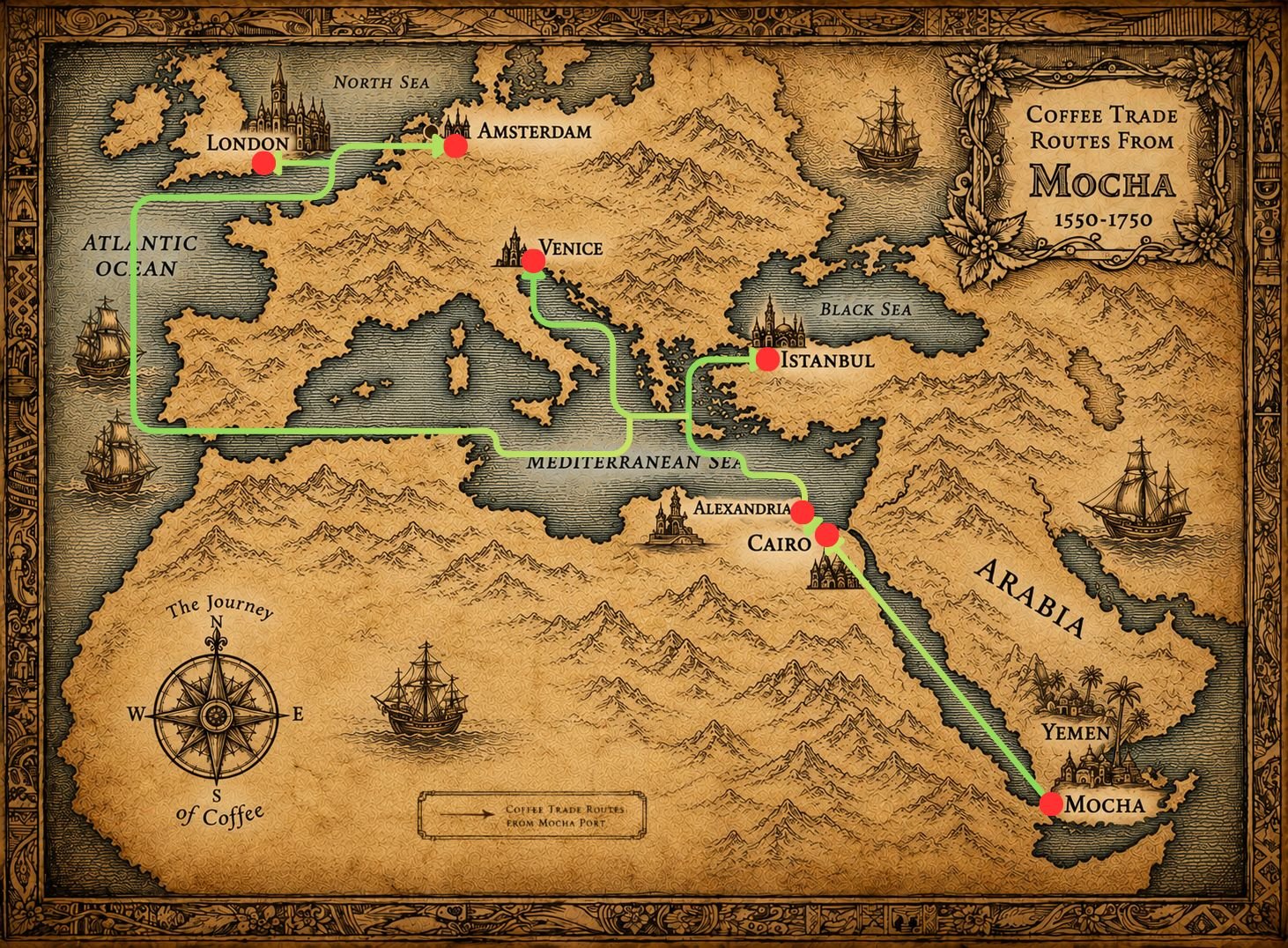
Map of coffee trade routes from Mocha to Cairo, Alexandria, Istanbul, Venice, Amsterdam and London, 1550–1750
Coffee trade routes from the Port of Mocha, 1550 – 1750
The Logical Question

If Ethiopia had coffee, why did every European power sail to Mocha for 200 years?

The Dutchcontrolled the Cape of Good Hope.
The Portuguesecontrolled the East African coast.
The Romansruled North Africa for centuries.
The Ottomanscontrolled both sides of the Red Sea.

All of them had maps of Ethiopia. All of them had soldiers, ships, and traders on the ground. All of them were desperate for valuable commodities.

And yet, every single one of them sailed to Mocha. Not Ethiopia.

The wild Ethiopian berry was not valuable. Yemen created the value.

The Invention Fallacy

The world accepts this logic everywhere — except coffee

Tomatoes are South American
↓
Pizza is Italian
Cacao is Amazonian
↓
Chocolate is Belgian
Potatoes are Andean
↓
French fries are Belgian
The wild coffee berry is Ethiopian
↓
Coffee is Yemeni

You do not credit the soil. You credit the civilization that transformed a weed into a global currency. That civilization is Yemen.

Today

We are YEMEN COFFEE. The same heirloom beans. The same dry-processing. The same mountain terraces. Unchanged since the Sufis. Uncompromised ever.

500 Years of History in a Cup

Shop Here